A useful website quote tells you what your business will receive, what you will pay after launch, and who will maintain it. The page count is only the starting point.
For a first budget conversation, MikirDigital's published website prices include simple landing pages from ₹9,999, WordPress websites from ₹19,999, and e-commerce projects from around ₹35,000. Corporate website guidance on our web design page is ₹19,999–₹60,000. These are examples from our own service pages, not a survey of Chennai market prices or a fixed quote for your project.
Use this guide to decide what you need and compare proposals on the same basis. A written proposal should confirm the current price, deliverables, taxes, third-party charges, and support before you commit.
Website costs at a glance
| Website type | Published MikirDigital price guidance | Scope to confirm |
|---|---|---|
| A landing page for one offer | From ₹9,999 | Design, copy, enquiry form, tracking, and the destination for each CTA |
| A WordPress business website | From ₹19,999 | Page count, editable areas, theme approach, plugins, and handover |
| A corporate website | ₹19,999–₹60,000 | Unique page layouts, service content, integrations, and review rounds |
| An e-commerce website | From around ₹35,000; the homepage describes projects up to ₹2,00,000+ | Products, variants, payments, shipping, content entry, and integrations |
| A custom web application | Quoted for the agreed scope | User roles, workflows, data migration, integrations, and testing |
Price references: website design, WordPress development, and homepage pricing, checked on 9 September 2026. The e-commerce service page shows ₹34,999 while the homepage rounds the starting figure to ₹35,000. Confirm the exact amount and inclusions in your proposal. Package labels on different pages are not interchangeable.
Start with the job your website needs to do
Generate enquiries for a service business
A consultancy, interior design studio, or local service business may need clear service pages, relevant examples of its work, and an easy way to enquire. Begin with the questions a prospective customer asks before contacting you: what you do, who you help, where you operate, and what happens next.
A five-page brief might include Home, About, Services, Work, and Contact. If you provide several distinct services, separate service pages may be more useful than squeezing everything into one page. Agree the actual page list before comparing prices.
Sell products online
A store needs more than a product gallery. Plan product variants, stock status, delivery areas, payment options, order emails, and returns information. Specify how many products the developer will enter and who prepares descriptions and images.
For an Indian retail business, ask the team to confirm the required payment methods and delivery rules with your chosen providers. A successful test payment alone does not demonstrate that refunds, failed payments, or order notifications work. Our e-commerce development service is the relevant starting point for a store brief.
Manage bookings or business workflows
An enquiry form requesting a callback is a different project from a booking system that checks availability, takes payment, and updates a calendar. Likewise, emailing an enquiry is different from creating and assigning a lead in a CRM.
Describe the steps the user and your team must complete. For custom functionality, a workflow diagram is often more useful than asking for “a website like” another business. Review custom web development when the brief includes accounts, permissions, or integrations.
What changes the price of a website?
Unique layouts and content
Ten pages using one approved layout involve different work from ten individually designed pages. Copywriting, photography, illustrations, and product data preparation also take time. State whether you will supply finished content or need help creating it.
If you need English and Tamil content, include translation, language navigation, editing responsibilities, and review in the brief. A language switch alone does not produce accurate translated content.
Editing and platform choices
If your team will update services, publish articles, or manage products, specify which tasks must be editable. WordPress, a hosted store platform, and a custom application have different operational responsibilities. Choose around those tasks, integration needs, and maintenance capacity; a platform name does not guarantee speed, rankings, or sales.
Connections to other systems
Name the CRM, booking tool, payment provider, or inventory system you want to connect. Explain what information moves, in which direction, and what should happen when a connection fails. External subscriptions and usage charges should appear separately from development work.
Launch preparation and migration
Replacing an existing site can require content migration, redirect mapping, image cleanup, and preservation of working enquiry routes. Share your existing URL early so the team can assess that work. The website redesign service covers a different brief from a first launch.
Compare the first-year cost and the renewal cost
Use this calculation when reviewing a proposal:
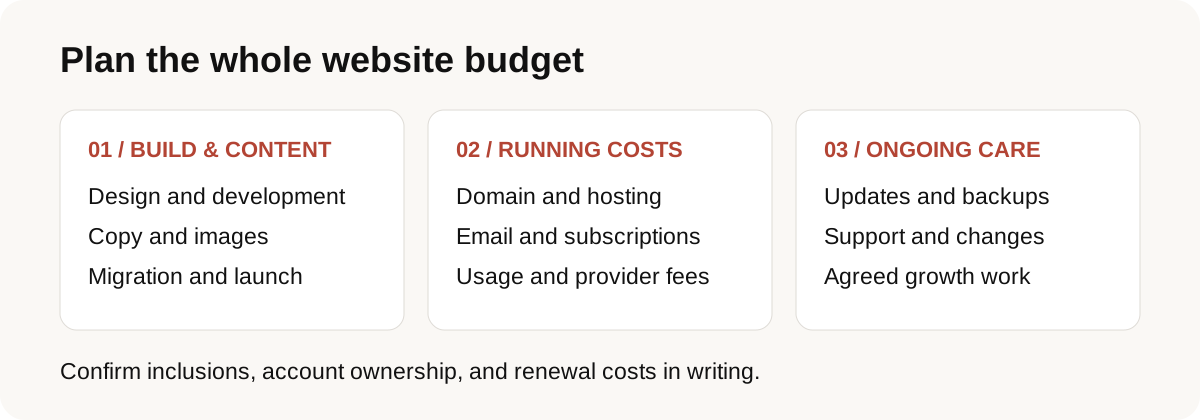
First-year budget = agreed build + content and migration + first-year subscriptions and hosting + agreed support + applicable taxes and usage charges.
Do not add an item twice if it is already included in a package. Ask for a separate year-two estimate: an introductory subscription price or included support period may end before then.
| Cost item | Ask the provider to confirm |
|---|---|
| Domain | Who owns the account, who renews it, and what the renewal costs |
| Hosting or hosted platform | Billing term, renewal price, backups, and usage limits |
| Whether business mailboxes are included and how extra accounts are billed | |
| Themes, plugins, and apps | Licence owner, renewal responsibility, and consequences of expiry |
| Content | Copy, photography, translation, product entry, and revision limits |
| Support and maintenance | Included period, response hours, update tasks, and charges for new work |
| Payment or other usage fees | Which provider charges them and whether they are separate from the build |
| Taxes | Whether each quoted amount includes applicable taxes |
For ongoing care, compare the tasks in a website maintenance plan with what your team can reliably handle. A launch warranty for agreed functionality and a continuing maintenance service are different commitments.
How to compare two website quotes fairly
Imagine two proposals for the same five-page service website. One includes only design and development using your supplied content. The other also includes writing the service pages, migrating the old website, and configuring enquiry tracking.
The headline totals cannot tell you which proposal is better value. First ask both providers to price the same scope. Then compare:
- Deliverables: named pages, unique layouts, editable sections, and integrations.
- Content responsibility: who writes, supplies, uploads, and approves each item.
- Quality checks: mobile navigation, forms, links, accessibility checks, and performance testing.
- Ownership: domain, hosting, CMS administrator access, source files, and licences.
- Revisions and changes: included review rounds and how additional work is priced.
- Handover and care: training, documentation, support hours, and the maintenance boundary.
A smaller scope can be the right decision. An inexpensive template build is not automatically unsuitable, and custom design is not automatically more effective. Judge whether the agreed work supports your customer journey and whether you can operate the site after launch.
What should “SEO included” mean?
Ask for an explicit list. A launch setup may cover crawlable pages, descriptive titles, sensible headings, internal links, image descriptions, canonical URLs, and a sitemap. For a redesign, it should also address changed page addresses and important existing content.
That is different from an ongoing programme of research, content improvement, technical work, and performance review. If attracting search traffic is a commercial goal, discuss SEO services as a defined scope rather than assuming a one-time setup includes continuous work.
Similarly, “analytics installed” should specify the actions being measured. Opening WhatsApp or clicking a phone number records an action; it does not prove that an enquiry was sent or that a customer bought. Ask how the website's reporting will connect to qualified enquiries recorded by your team.
Set practical launch acceptance checks
Before final approval, walk through the website as a customer:
- On a phone, can you find the right service, read its details, and contact the business?
- Does a form explain what happens next, including whether it opens another app?
- Do calls, email links, and other agreed contact options work?
- Can your team make the content changes included in the brief?
- For a store, have agreed checkout, payment failure, order email, and refund journeys been tested?
- For a redesign, do important old links reach the correct replacement pages?
- Are account access, renewal dates, and recovery instructions documented?
Agree who checks each item and how issues are resolved. These checks make a proposal easier to evaluate than a vague promise of a “premium” or “SEO-friendly” website.
Prepare a brief that gets you a useful quote
Copy these prompts into your enquiry:
- Business and customers: what you offer and who should use the website.
- Main outcome: enquiries, bookings, purchases, or a specific internal task.
- Pages and features: launch essentials, plus a separate list for later.
- Content: what is ready and what needs writing, photography, or translation.
- Existing website: the URL and anything that must be retained.
- Integrations: the named tools and the information they need to exchange.
- Operations: who will edit the site and maintain it after launch.
- Timing and budget: your preferred launch date and a comfortable investment range.
Ready to turn your brief into a scope? Request a website quote from MikirDigital. Share the page list, required features, and any existing website so we can discuss the deliverables and costs. The contact form opens WhatsApp with a draft for you to review and send.
Frequently asked questions
How much does a five-page website cost in Chennai?
MikirDigital's homepage lists a Web Starter package from ₹19,999 for up to five pages. Treat that as published starting guidance. Content creation, custom features, subscriptions, and support requirements can change the proposal; confirm inclusions and the current price in writing.
Are domain and hosting included in the website price?
Do not assume they are. Ask whether they are included, for how long, who owns the accounts, and what you will pay at renewal. The same check applies to email, premium plugins, and hosted platform subscriptions.
How much should I budget for an e-commerce website?
Our homepage describes e-commerce projects from ₹35,000 to ₹2,00,000+. The relevant scope depends on the catalogue, variants, design, integrations, and operating requirements. Platform subscriptions and payment-provider charges need separate confirmation.
Will a cheaper website rank worse on Google?
Price alone does not determine rankings. Useful content, technical accessibility, competition, and other search signals matter. Compare what each proposal actually delivers and avoid treating a more expensive build as a ranking guarantee.
How long will the website take to build?
Our website design page gives a typical timeframe of four to eight weeks. Your project schedule depends on scope, content readiness, review stages, and integrations. Confirm a timeline against your brief, especially for a redesign or store.
Can I reduce the initial cost without losing essential functionality?
Yes: launch with the pages and tasks customers need first, supply approved content promptly, and defer features that do not support the initial goal. Keep contact routes, necessary testing, account ownership, and handover in the agreed scope.